
Why I care about AI, and you should, too.
What if the real value of AI isn’t automation and efficiency, but human connection?
by Steve Whitby
I didn’t come to technology through technology.
That probably matters.
The first part of my career was spent in higher education. For more than a decade, I worked alongside students, volunteers, and professional staff trying to create meaningful experiences and stronger communities. After that, I spent fifteen years as a pastor. Today, I spend most of my time helping organizations design products, build software, and increasingly, figure out what role artificial intelligence should play in their future.
Looking back, those three chapters of my career seem very different from one another. One was centered on student development and leadership. One was centered on faith communities. One is centered on technology and human/digital experiences. But the longer I do this work, the more I think they were all teaching me the same lesson.
People matter. Systems matter too, but only because they create the conditions for people to do meaningful things together.
The Problem Most Mission-Driven Organizations Share
That’s why I’ve become increasingly interested in AI.
Not because I think technology is the answer to every problem. Not because I think we’re racing toward some inevitable future that everyone needs to embrace without question. And certainly not because I find the endless parade of new tools particularly exciting on its own.
I care about AI because I care about organizations, and most organizations I know are struggling with the same challenge: they are rich in purpose and starved in capacity.
The nonprofits, associations, membership organizations, foundations, schools, churches, and service organizations I spend time with are rarely short on ideas. They know the experiences they want to create. They know the relationships they want to build. They know the support they want to provide.
What they don’t have is enough time.
There is always another member to onboard. Another volunteer to train. Another donor to thank. Another student to support. Another report to write. Another email to answer. Another program that deserves more attention than anyone can realistically give it.
The result is that good organizations make compromises every day.
Not because they don’t care.
Because they have to.
What the Best Technologies Actually Do
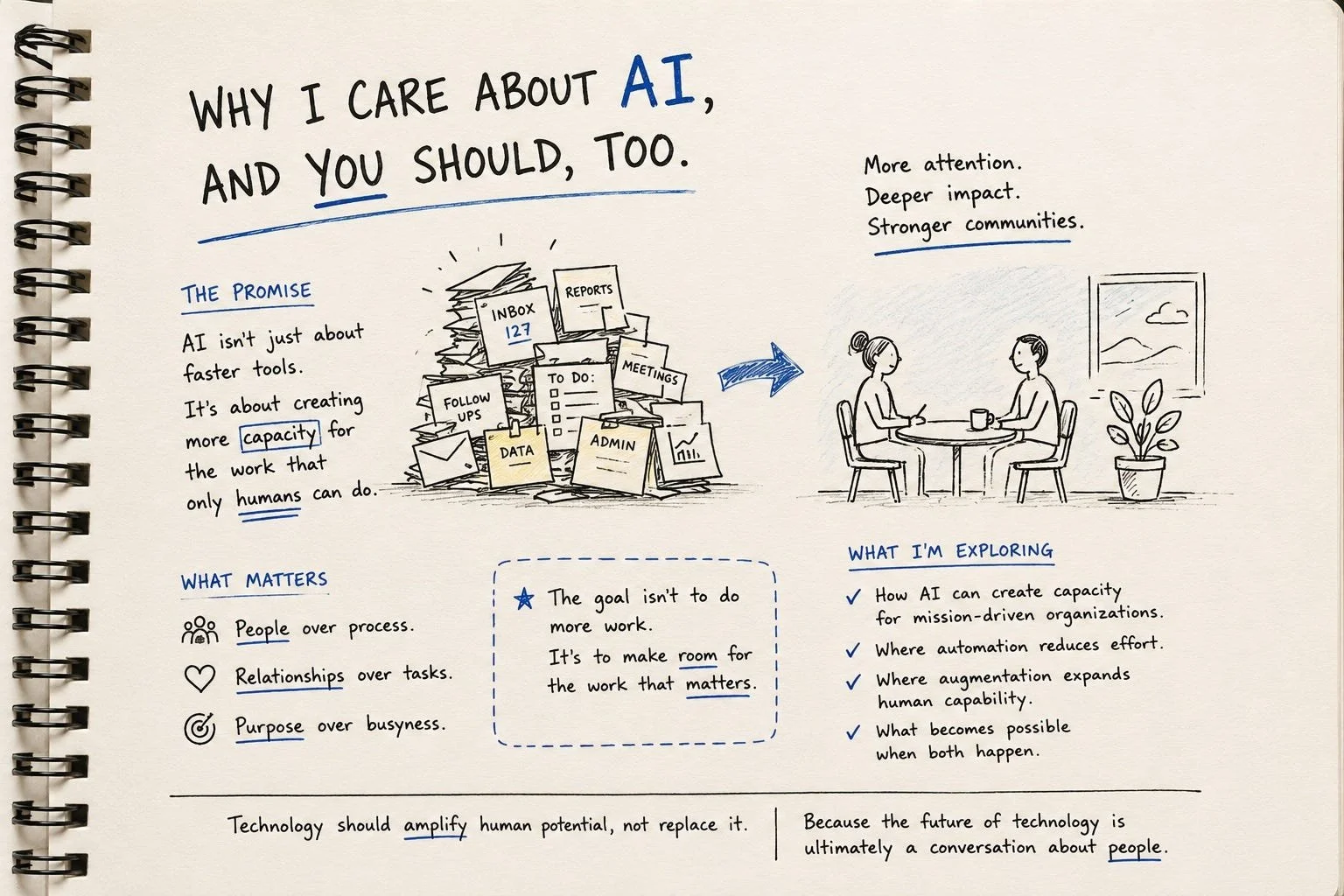
That reality has shaped the way I think about technology for a long time. The most valuable technologies I’ve encountered were never the ones that replaced human relationships. They were the ones that created more room for them.
A calendar doesn’t matter because it’s a calendar. It matters because it helps people coordinate their lives. A CRM doesn’t matter because it stores data. It matters because it helps someone remember and strengthen a relationship. The best technologies don’t remove humanity from the process; they remove friction so humans can spend more time doing what only humans can do.
That’s the lens through which I think about AI.
Starting with the Wrong Question
Much of the public conversation around AI focuses on tools. Which model is best? Which platform should you buy? Which company is winning? Every week seems to bring a new announcement, a new acronym, or a new prediction about how everything is about to change.
I understand the fascination, but I think those conversations often start in the wrong place.
The more important question isn’t, “What AI tool should we use?”
The more important question is,“What are we trying to make possible?”
That’s a very different conversation.
It shifts our attention away from technology and back toward capability. It forces us to think about where we’re constrained, where we’re struggling, and where we wish we could do more than our current resources allow.
Can we provide better support to members? Can we make institutional knowledge easier to access? Can we help staff spend less time processing information and more time acting on it? Can we give small teams capabilities that previously required specialized expertise or additional headcount?
Those are the questions that interest me.
The Untapped Asset Most Organizations Are Sitting On
And they’re particularly interesting in nonprofit and mission-driven organizations because these organizations sit on a combination of assets that is more powerful than many people realize.
Most are resource-constrained. Many are data-rich.
For decades they’ve accumulated stories, records, relationships, training materials, institutional knowledge, member histories, event data, engagement patterns, and operational experience. Much of that knowledge exists, but it’s trapped. It’s buried in folders, scattered across systems, locked inside documents, or carried around in the heads of people who have been doing the work for twenty years.
For the first time, we’re beginning to see technologies that can help organizations unlock and use that knowledge in meaningful ways.
Not perfectly. Not magically. But meaningfully.
What AI Won't Change
That doesn’t mean AI will solve the hardest problems organizations face.
In fact, I suspect the most important challenges will remain stubbornly human.
Leadership is still leadership. Culture is still culture. Trust is still trust. No model is going to navigate a difficult conversation between colleagues. No algorithm is going to earn credibility with a volunteer who feels unheard. No system is going to create a sense of belonging on its own.
The work at the center of healthy organizations has always been human work, and I don’t see that changing. What may change is the amount of space we have available for that work.
The Real Benefit: Attention Reclaimed
One of the things I’ve noticed throughout my career is that organizations rarely struggle because they don’t know what matters. Most leaders can tell you exactly where they wish they could invest more time. They want deeper relationships with members. They want better coaching for volunteers. They want more thoughtful onboarding, better communication, stronger follow-up, and a clearer understanding of what’s happening across the organization.
The challenge is that all of those things compete with the day-to-day operational gravity that pulls on every organization. Reports need to be written. Requests need to be answered. Information needs to be tracked, moved, summarized, reviewed, and shared. The work is necessary, but it has a way of consuming the very capacity required to improve it.
That’s what makes this moment interesting to me.
Not because AI can do remarkable things. It can.
What’s interesting is the possibility that some of that operational weight can finally be lifted. Not eliminated entirely, and certainly not without thought and intention, but lifted enough that people can spend more of their energy where it creates the most value.
The real benefit won’t be measured in hours saved.
It will be measured in attention reclaimed.
Attention for the member who needs support. Attention for the volunteer who’s trying to lead. Attention for the student who’s searching for belonging. Attention for the donor, the staff member, the colleague, or the community partner.
The organizations I care most about exist to help people grow, connect, learn, contribute, and flourish. If technology can help create more capacity for those things, then it’s worth taking seriously.
My goal isn’t to convince you that every new technology deserves your attention.
It’s to explore how we can use the right technologies to create more capacity for the work that matters most.
Because at the end of the day, that’s why I care about AI.
Not because of what it can do.
Because of what it might make room for.
Published on Steve’s Substack.
About Steve Whitby
Drawing on decades of experience, Steve helps people act with clarity and responsibility. He is focused on facilitating human connection and relationships built to last because they are established in trust, alignment and purpose.
He’s a creative, strategist and the solutions engineer that you want in your ear. His work is ultimately about helping organizations and communities in moving forward.
Looking to move past the AI hype and focus entirely on your organization's capability. We can work together to identify your specific bottlenecks and map a practical path forward for your organization.